


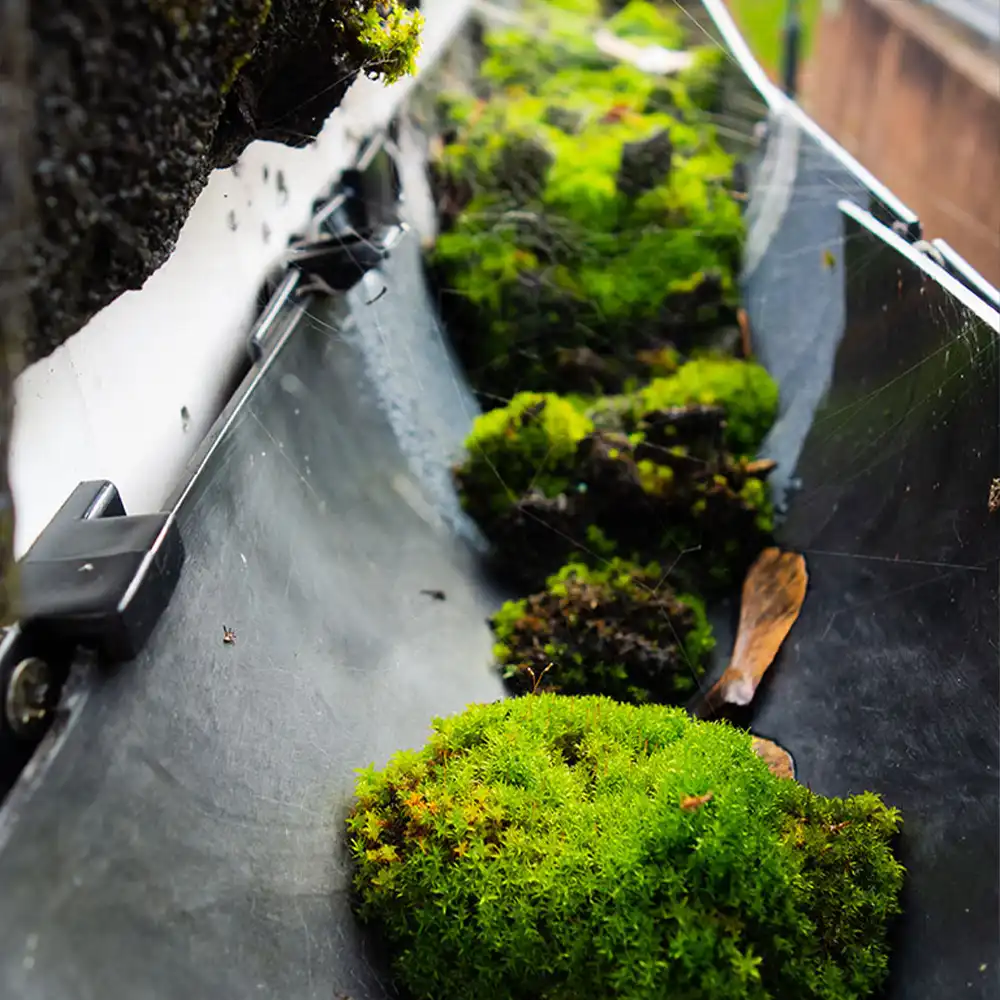
Blocked gutters cleared across Chatham, Gillingham, Rochester, Strood and Rainham. Terraces and detached alike, all done from ground level.


Rear access is usually a shared alley, a locked gate, or straight through the house. Streets are narrow and parked up. Getting a ladder round the back of a terrace in Chatham or Gillingham is a job in itself before anyone has touched a gutter.
We work entirely from the ground with a high reach vacuum system, which takes most of that out of the equation. No ladders through your hallway, nothing propped against the building, and no scaffold needed on a three-storey.
We’re based in Ashford and out across Medway regularly, covering Chatham, Gillingham, Rochester, Strood and Rainham.
Gutter Cleaning


A lot of Medway's guttering is a good deal older than the people living under it.
Plenty of the terraces around Chatham, Gillingham and Luton still have their original cast iron, and cast iron doesn’t forgive neglect. Once water sits in it the joints corrode and it starts weeping down the brickwork. The Victorian stock in Rochester has the same issue, with the added complication that a fair bit of it is listed or sits in a conservation area.
Out at Rainham, Wainscott and Hempstead the housing is newer and the guttering is plastic, which is more forgiving but sits lower and clogs faster.
Then there’s the river. Salt air, gull nesting on the flat-roofed extensions around the docks, and moss that grows quickly in the damp coming off the estuary. Gutters here fill faster than they do inland.


On a Victorian terrace, a blocked gutter isn't a cosmetic problem for long.
Solid brick walls with no cavity have nothing to stop water getting through once the brickwork is saturated. Overflow from a blocked gutter runs down the same stretch of wall every time it rains, and eventually it shows inside.
Working from the ground matters here too. On the steeper streets around Chatham and Luton, footing a ladder safely is a job in itself, and a ladder against hundred-year-old cast iron is how a cleaning job turns into a repair.
Once a year is the minimum. If you back onto trees or you’re close to the river, twice is more sensible.


The full run, not just the section that's obviously blocked.
If we find something the vacuum can’t deal with, such as a badly compacted valley gutter or a section that’s come away from the fascia, we’ll tell you at the time rather than working around it. On older cast iron that’s worth knowing about before winter rather than after.
Where we cover
Chatham, Gillingham, Rochester, Strood, Rainham, Walderslade, Lordswood, Hempstead, Wainscott, Frindsbury, Luton, Twydall, Cuxton, Halling and Hoo, plus the surrounding villages on the peninsula.
We also work right across the rest of Kent, including Ashford, Maidstone, Canterbury, Tunbridge Wells, Sevenoaks, Folkestone, Dartford and Gravesend.
Not sure if we come out your way? Give us a call and we’ll tell you straight away.
We also cover Tonbridge, Dover, Deal and everywhere in between.
Gutter Cleaning
The things people ask most before booking.
Tell us what needs cleaning and we’ll come and look at it. No charge, no obligation, and a fixed price in writing before anything starts.
Yes, and it usually works out cheaper per property. Because guttering on a terrace runs continuously, clearing one house while the next stays blocked often means the problem comes back. If you can get your neighbours on board we'll quote for the run.
Yes. Because we work from the ground with a vacuum rather than putting ladders against the building, there's no contact with the fabric of the property at all. Worth mentioning when you call so we can talk through any access restrictions.
It depends on the size of the property and how much guttering there is. A mid-terrace is usually at the lower end, a detached with a conservatory towards the higher. We give you a fixed written quote before starting, and there's no charge for coming out to look.
Usually yes, since the vacuum works from ground level and we need to reach the rear guttering. You don't need to be in as long as we can get round. Let us know about locked gates, alleys or dogs when you book.
Once a year for most properties. If you back onto trees or you're close to the river, twice is more sensible, since the damp coming off the estuary means moss grows back faster than it does inland.